

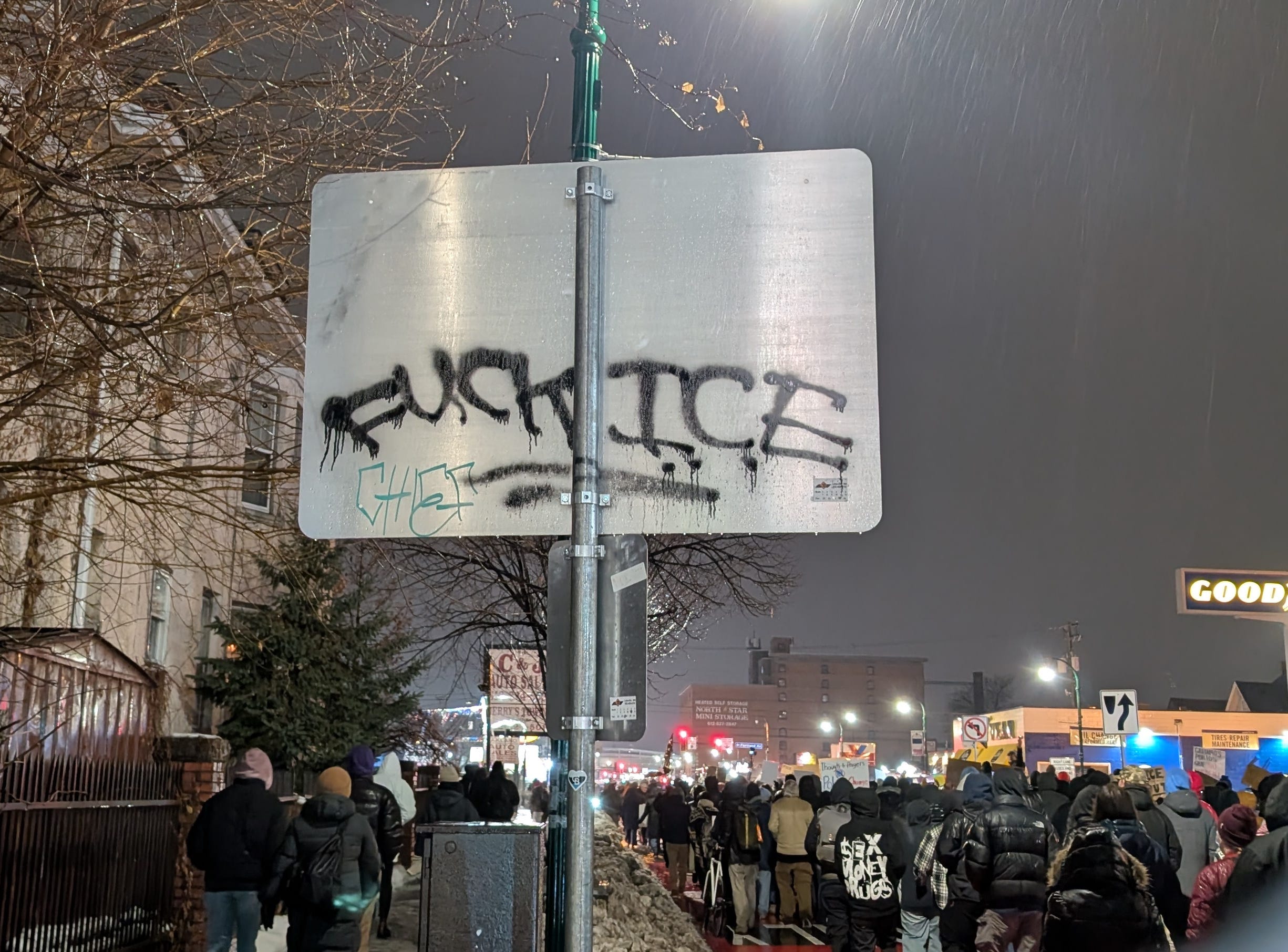
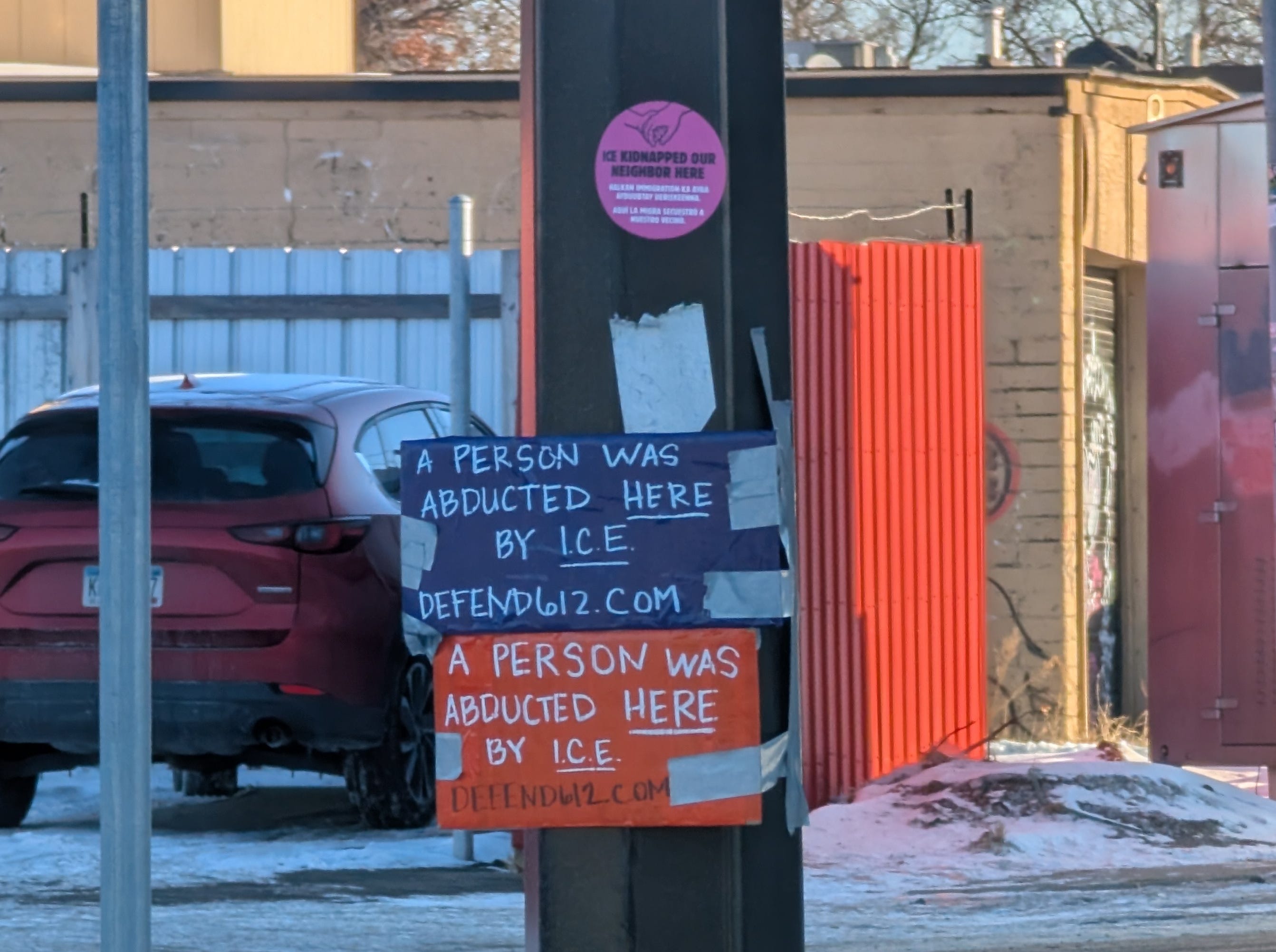
For three months this winter, the Twin Cities was occupied by a small army of federal agents here to disappear our neighbors. They kidnapped children and detained grandparents, shot protestors in the street and killed immigrants in detention. The overwhelming ubiquity of this terror campaign was impossible to ignore. While ICE abducted Minnesotans from street corners and bus stops, schools were forced into remote learning, businesses closed or lost employees, and patients skipped medical appointments. With a force of over 4,000 at its peak, the Department of Homeland Security (DHS) presence in Minnesota outnumbered the ten largest police departments in the metro area combined. Even after the official end of Operation Metro Surge, the secret police have simply dispersed into the suburbs.
But this winter in Minnesota also saw unprecedented participation in anti-fascist resistance. Beyond large marches and demonstrations, 30,000 Minnesotans have been trained as legal observers for ICE raids, thousands more delivered groceries to immigrant families staying home, dozens of neighborhoods hosted mass meetings to help more people plug in, and protestors showed up in the night with all manner of noise-makers to nearly every hotel confirmed to be hosting ICE. Immigrant-led non-profits played an indispensable role in setting up the resistance infrastructure and religious institutions have been essential mutual aid hubs, but much of our organizing has been decentralized, leaderful, and spontaneous.
In stark contrast to the sense of powerlessness engendered by status quo politics, our nascent mass movement has proved a formidable thorn in the side of the Trump regime by effectively wielding power in four key areas: in the streets, on strike, through the state, and on our screens. The Minnesota resistance has not been immune to old patterns of performative action that makes people feel powerful without actually being powerful, but enough participants chose strategic interventions to force real, if modest, concessions; our pressure ended the careers of Customs and Border Protection (CBP) Commander Greg Bovino and Homeland Security Secretary Kristi Noem, and compelled the Trump regime to reduce the number of agents here. In what follows, I will explore what makes street power, strike power, state power, and screen power each necessary in our local struggle against ICE and how we can utilize them to build socialism going forward. Much of this analysis is indebted to my friend and comrade Lena P, who was originally my writing partner for this piece and contributed invaluable insights.
Street Power
After the murder of George Floyd in 2020, Minneapolis exploded into a massive, Black-led popular uprising. Along with a robust mutual aid network, the uprising also directly challenged the authority of the state. Rebels set fire to a police precinct and occupied the intersection where Floyd was killed for over a year, refusing entry to police at its peak. As the Minneapolis Police Department focused on putting down the uprising, neighborhoods organized their own community patrols to keep each other safe, a tactic first developed by the American Indian Movement five decades earlier. Despite the romantic memory some still carry, the uprising was fraught with race and class contradictions, and it failed to translate the organic mobilization into systemic change. But to call the uprising itself a failure misses its role in the broader process of class formation. The block-by-block organizing and widespread radicalization of 2020 laid the foundation for our resistance to ICE now.
Street power is the ability to shape the course of events playing out on our literal streets. Minnesota has been able to mobilize large crowds during this occupation, drawing between 50,000 and 100,000 to a single march, but our street power has been most effective when diffused in our own neighborhoods. Relying first on group chats and relationships formed in 2020, the old system of community patrols was transformed and expanded outside of Minneapolis into a network of Signal groups dedicated to tracking ICE and deploying observers.
In the early days of Metro Surge, large-scale raids would prompt non-profits to mass text trained observers who would mob the scene, sometimes even preventing arrests. ICE learned from these incidents and adapted. They moved in smaller numbers, earlier in the morning, and attempted to abduct people as quickly as they could, leaving the demonstrations of force mostly to Bovino and CBP once they arrived. Very quickly, the centralized non-profit infrastructure was overrun (the MONARCA hotline was fielding more than one call per minute) and we had no choice but to adapt too.
At the core of the rapid response network are local Signal groups or varying geographic size. Regularly reaching the 1000 user limit for Signal chats, these groups refresh daily so that only those spending time on rapid response that day are in them. Active responders will join the voice call in their local chat and patrol a neighborhood usually in a car, sometimes on foot. Meanwhile, as many as three "dispatchers" will watch the text chat for credible reports of ICE, check license plates against the crowd-sourced database, and communicate with other local chats. ICE license plates themselves are primarily recorded by observers at the Whipple Federal Building (the DHS command center), who also alert dispatchers to large convoys headed in their direction.
Branching off of this system, hyperlocal groups coordinate neighborhood specific rapid response, mutual aid, and distribution of know-your-rights materials. Complimenting mobile rapid responders, stationary observers protect schools, mosques, churches, and other community institutions at high-traffic times, a tactic spearheaded by parent groups originally organized to support the recent Minneapolis Federation of Educators contract campaign. More aggressive tactics emerged as well, like “filter blockades” at strategic intersections or improvised barricades erected in an attempt to prevent federal agents from fleeing the scenes of their crimes. Many who cannot participate in these ways have devoted hours to data entry and organization. When JD Vance derides the “very unique, very Minneapolis specific” response to ICE or Greg Bovino complains that we are “a bit better organized” here, they're damn right.
Most remarkable about the rapid response network is the unshakable courage of its members. Despite widespread intimidation—including leading observers to their own addresses, arrest, brutalization, chemical weapons, car-ramming, murder, and the thinly veiled threat of murder—Minnesotans have not backed down. Thousands of rapid responders, myself included, experienced moments of serious risk to their personal safety and chose to continue showing up in defense of their neighbors. There is a strong sense of collective pride in our resilience and steadfast commitment.
Our street power has been effective despite, or perhaps because of, our lack of formal leadership. Everyday working class people have taken ownership of this movement. There are no marching orders, just figuring out together which direction to walk in. Organized socialists are deeply embedded in the resistance, but we remain a small, if influential, minority. As working class movements continue to grow, there will inevitably be more confrontations with the enforcers of capital. We are going to need capable street power to defend socialist goals, and we are unlikely to achieve it by declaring ourselves in charge of spontaneous mobilizations. Our task, as outlined by Marta Harnecker, is not to command but to convince, to bring grassroots movement leaders into our political project and empower them to carry it out.
Strike Power
For the first time in 80 years, organized labor across industries in an American city unified to walk off the job together in a general strike on January 23rd. We are lucky in Minnesota to have unions that have flirted with coordinated strike action before, but the 23rd still represented a major escalation in the tactics of our local labor movement. Never before in the history of our state—home to the first recorded sit-down strike in the US and one of its most militant general strikes—have unions acted collectively for a work stoppage while under contract with their employers. One poll estimated that nearly 9% of registered voters statewide skipped work, with an additional 14% participating in other ways.
Strike Power is the ability to withhold our labor in order to deprive the ruling class of the value we create. While street power confronts the secret police directly, strike power takes the fight to the economic actors backing the Trump regime. Billionaires spent a combined $2.6 billion in the 2024 election, overwhelmingly for Republicans, and contributed the large majority of funds spent by outside groups in favor of Trump. Trump could not have been elected again without the influence of the billionaire class and his power largely depends on their continued support.
The billionaire class benefits directly from this assault on our immigrant neighbors. Most clearly, the significantly expanded ICE budget has won billions in lucrative contracts for Trump’s largest corporate donors, but immigration enforcement also serves capital by intensifying the exploitation of immigrant workers. ICE terror campaigns undercut workers’ rights and hinder organizing, even targeting outspoken union leaders. The intended result of such tactics is to bully an entire section of the work force into submission. The threat of ICE has for years been a common tool used by bosses to abuse labor and retaliate against organizers. Raids may disrupt production for businesses that employ immigrant workers, but they simultaneously allow those businesses to disregard the minimum wage and labor protections of the workers who are left behind. Deported workers are even further exploited by US corporations seeking cheap labor in undeveloped countries. So while Stephen Miller and MAGA extremists may have ideological interests in mass deportation, the billionaire class has material interests. Make no mistake: ICE is advancing white supremacy, but ICE is also waging the class war.
The general strike has a long history as one of our most potent democratic tactics for disrupting corporate profits, forcing political concessions, and challenging billionaire control over the economy. Without our labor, businesses close, commerce stalls, and the wheels of capitalism stop turning. The moment supporting the regime stops being profitable, the billionaire class will abandon it.
January 23rd was a monumental step in the right direction, but we are still a long way from a labor movement strong enough to topple fascism, much less anchor a movement for socialism. Organized labor is the backbone of working class power and our first line of defense against the oligarchy. I will leave it to others to theorize the role of organized socialists in developing a left-labor bloc, but meanwhile Twin Cities DSA members are organizing for the next strike. Within our unions, the rank and file were excluded from key decisions for this strike. To hear the president of SEIU Local 26 tell it, union leadership called the strike after a private call with only a fraction of their membership. We are fighting for democratic decision making institutionally and building it ourselves in workers assemblies. Outside of the established labor movement, the large majority of workers in Minnesota remain unorganized. Like the corporate and retail employee organizing against ICE at Target, socialists are taking advantage of opportunities opened by this moment to bring a larger share of the working class into struggle.
State Power
The Minnesota resistance has demonstrated how much working people can accomplish by acting together, but it has also highlighted the absolute necessity of contending for state power. The Twin Cities easily surpassed the oft-vaunted 3.5% rule and yet remain heavy underdogs. Many of our local officials, most notably Mayor Jacob Frey and Governor Tim Walz, have done little except talk in front of TV cameras and file lawsuits against an agency that violated nearly 100 court orders in January alone. Facing hostile forces in the federal government and toothless actors at the state and local level, our movement is stretched to its limits just trying to prevent harm. To have socialist control of local government would only strengthen our ability to fight back.
State Power is the ability to control and wield state resources. In fairness to politicians like Frey and Walz, there are limits to the way Minnesotan officials can safely exercise state power under these conditions without risking armed conflict between different levels of government. Still, DSA-endorsed city council members in Minneapolis and St Paul led the charge to strengthen both cities’ separation ordinances to prevent municipal collaboration with ICE, secure millions of dollars in rental assistance for residents unable to go to work, fight to extend required notice before evictions, delay liquor licence renewal for hotels housing ICE, and investigate police response to protests. At the state capitol, socialist legislators have advanced bills to prohibit state and local agencies from sharing data or otherwise collaborating with ICE, ban 287(g) agreements with DHS, and enable Minnesotans to sue federal immigration enforcement in state court. DSA electeds have also taken on important leadership roles in the grassroots resistance. Some liberal politicians have joined our socialists-in-office in these votes and actions, but Frey and Walz are at best doing nothing and at worst in the way.
A mayor of Minneapolis accountable to our mass movement could have the city distribute know-your-rights materials to every business and residence, and find emergency shelter for all of our unhoused neighbors to protect them from ICE harassment and kidnapping. Instead, Jacob Frey vetoed the eviction notice extension ordinance and used his sudden national platform to speak against the abolition of ICE. A governor accountable to our movement would have actualized the widespread demand for an eviction moratorium. They could have ended Department of Corrections collaboration with ICE, directed state agencies to hold the rental car companies supplying ICE accountable for license plate tampering, or called a special legislative session to move anti-ICE bills sooner. The governor could have even shut down ramps to state highways 55 and 62 leading out of the Whipple Federal Building to make it harder for ICE to get around the metro area. Instead, Tim Walz sent the National Guard to the Whipple to contain protest while negotiating behind closed doors with the Trump regime.
Operation Metro Surge was a violent reminder of what is at stake in the contest for state power. Liberal leadership failed working class Minnesotans in the midst of crisis, choosing legal procedure and wealthy landlords over the urgent needs of the people. This ineffective politics of capitulation to capital helped create the conditions for fascism to arise in the first place. To defeat it, our electoral projects must advance transformative reforms that enhance our street and strike power and polarize along class lines.
Screen Power
Screen Power is the ability to capture broad public attention and win the narrative battle about what is happening on the ground through primarily digital tools. Minnesotan screen power is most clearly manifest in the viral videos of the Renee Good and Alex Pretti murders, but this is not the first time that filming state violence brought Minnesota into the national spotlight. From Jamar Clark to Philando Castille to the infamous bystander video of George Floyd, Black Minnesotans have long used cell phones to document police murder of our neighbors and disseminate the evidence across social media when mainstream news outlets ignored these stories. Videos spread through grassroots networks online became a core feature of the Black Lives Matter movement and significantly shaped public opinion on police and public safety.
Primed by years of watching state violence play out on our screens, neighbors on Portland Avenue started recording at the first sign of escalation on the day Renee Good was killed. Governor Walz’s admonition to “hit record,” coming a full week after Good’s murder, only reminded us of what Black organizers in Minnesota have been saying all along: the repressive arm of the state is never a reliable narrator of its own actions, no matter whether its agents wear a mask or a badge.
Our screen power was effective because it escaped the left and liberal echo chambers where we were always going to attract attention. Even after the news cycle moved on from Good, Minnesota held onto the spotlight through mass participation in the resistance to ICE. So when Alex Pretti was shot 10 times by CBP, his murder broke containment online. ICE and CBP’s actions were widely condemned in a variety of “typically apolitical online spaces,” demonstrating the digital reach that our movement already had and fortifying our advantage in the narrative battle. Recent research has found that content creators in these non-political forums are among the most effective online messengers for changing minds on political issues. For instance, much was made about the viral, well-produced videos released by the Zohran Mamdani campaign, but he dominated social media in large part because New York-based influencers who might otherwise be posting get-ready-with-me’s or celebrity commentary were flooding the internet with Zohran endorsements. Our ability to continue winning over mostly apolitical content creators is crucial to form permission structures for the MAGA base to defect and build a durable majority against fascism.
Social media is unique as a mass communication tool where regular people can, to some extent, collectively shape the narrative through likes and shares. Trump and the billionaire class recognize this power, which is why recently-acquired TikTok is allegedly censoring anti-ICE content, fascist influencers came to Minnesota in droves, and ICE itself is filming propaganda for social media on the job. The digital age demands of organized socialists a comprehensive digital strategy. In addition to presenting a coherent alternative to the ideologies propagated by editorial boards and cable news pundits, we should pursue a culture of implicit support for socialist ideas online by bringing in creators with existing audiences.
Towards a Mass Politics
Through power in the streets, on strike, through the state, and on our screens, Minnesota effectively beat back a fascist occupation. What made each successful was not ideological dogmatism but mass participation. The resistance is made up of mostly liberals who, while increasingly frustrated with the Democratic establishment, remain committed to the party and do not share our end goals of establishing a socialist society. Yet the struggle is changing them. There is no better demonstration of the failure of establishment politics than to buy groceries for the family down the street, come face to face with masked thugs outside of your kid’s school, walk off the job for the first time, and watch the politicians you once trusted do almost nothing. Minnesotans are waking up to the need for a more radical agenda to combat Trump, and they are growing weary of the pace of change. To defeat fascism and win over our neighbors to socialist politics requires more than a clearly articulate alternative to the status quo. Organized socialists must entice our neighbors into political struggle, develop their leadership, and wield power together strategically to deliver tangible gains.