
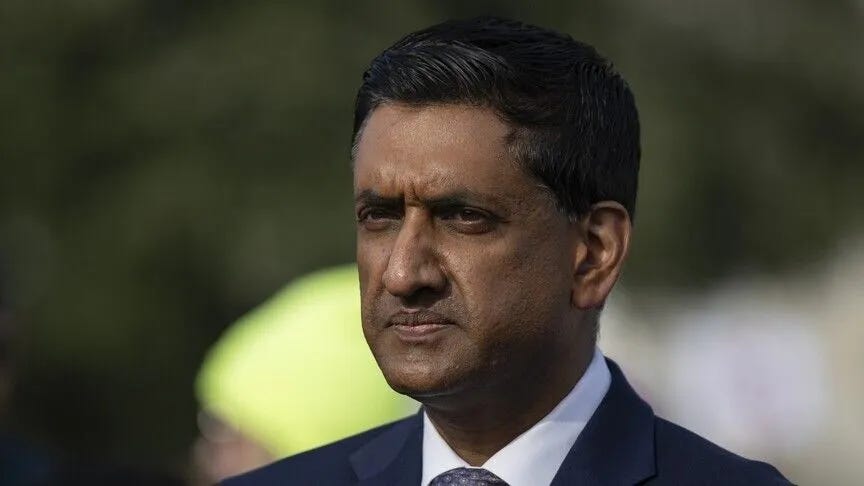
When I imagine my dream presidential nominee for 2028, I don’t envision a supplicant to tech oligarchs and the crypto lobby, whose politics are as inconsistent as they are indecipherable, and who has beelined for policies both idiotic and uninspired. But then again, I don’t have brain damage from huffing Musk’s algorithms all day, like Ro Khanna’s supporters. I can’t see the elegant strategy of groveling before the Trump administration or changing my mind every 30 seconds. Perhaps if I bash my head with a hammer it’ll all become clear.
The idea that Ro Khanna, who so prominently embraced DOGE in its early days, is going to be the next Democratic nominee for president is nothing but the worst kind of political narcissism on his part, and ridiculous flailing from the fringe on the part of his supporters. That they are excited by the idea of handing the awesome powers of the presidency and the immense opportunity of the moment to a man whose political decision making is so infamously bewildering it spawned the “Ro Khanna cycle” meme would be funny if it weren’t so pathetic. To act like he is a serious contender for the nomination is to play pretend—he has no better odds than the litany of also-rans who lined the stages of 2020 debates whose names none but the sickos remember.
The biggest strike against Khanna is his persistent attitude and approach towards big tech and tech oligarchs. While he has since tried to bury it, in the immediate aftermath of Trump’s victory, he was quick to try (and seemingly fail) to cozy up to Elon Musk, calling on Democrats to work with DOGE. Beyond the clearly fraudulent data harvesting, and the firing of hundreds of thousands of federal employees—bad enough on their own—DOGE is also responsible for the deaths of well over half a million people, mostly children. Khanna has since walked back his early praise for the program, but he can’t take back lending legitimacy to it during that early critical period.
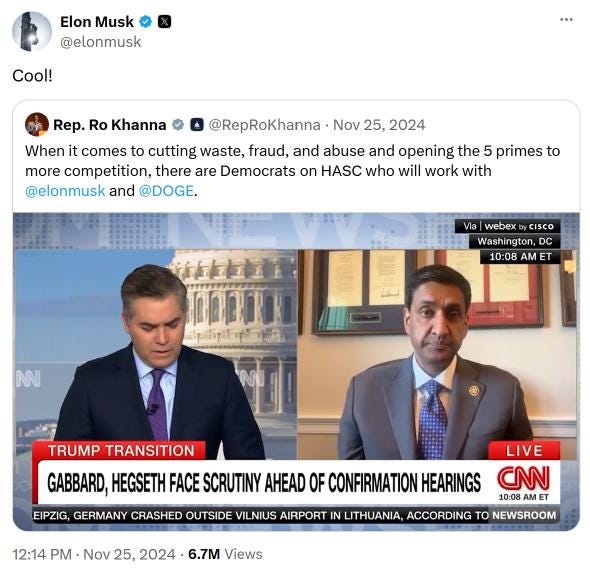
Yet we should be under no illusions that this is a one-off event, far from it. Khanna’s support for DOGE is rather emblematic of his persistent approach to tech. After Musk departed from his position as “shadow president” and began publicly feuding with Trump, Khanna attempted to court him, despite the Tesla CEO’s bottom of the barrel approval ratings, lower even than Trump’s. He also urged Democrats to remain on X, skipped a vote to subpoena Musk, and laundered his supposed beliefs in “free speech.” Khanna’s support for tech oligarchs isn’t limited to Musk, he is both invested in Palantir and received campaign funds from them until only a few months ago. On top of this, despite what his press releases might say, Khanna is also pro-crypto, and he voted for both the CLARITY Act and the GENIUS Act, both important pieces of the crypto agenda in congress.
None of this should be especially surprising though. Not only is Khanna incredibly wealthy, even for a member of congress, he is also one of congress’s most prolific stock traders (a contradiction with his stated stance on the issue), and is the representative for CA-17, which includes Silicon Valley. All of this causes him to fundamentally misunderstand that the American people, especially young voters, hate our tech oligarchs. We don’t want a return to an Obama-era style of close friendship between our next presidential nominee and tech CEOs, we want heads on pikes.
Khanna’s inconsistency is not limited to the tech sector. While he has frequently stated his opposition towards Hindutva, the far right ideology of India’s ruling BJP party, Khanna also lobbied for Indian Prime Minister Narendra Modi to address a joint session of congress, and has received over $110,000 from Hindu nationalist groups. Not content with fascists from abroad, he also enjoys flirting with homegrown ones as well, such as acting like JD Vance is actually anti-war and endorsing noted racist Thomas Massie.
Many of his other endorsements don’t exactly shine a good light on him either. He endorsed close Eric Adams ally Jenifer Rajkumar in both her initial election to the State Senate in 2020, and her failed attempt to unseat Jumaane Williams as public advocate in 2025. And unlike a certain other left-leaning member of congress considering a presidential run, he was also a strong backer of disgraced Senate nominee Graham Platner, going so far as to fly out to Maine to do a large rally for him in the immediate aftermath of allegations of domestic violence.
For Khanna’s more left wing supporters, a foundational claim is that he is better and more reliable on Palestine than others. This is a hallucination. The USCPR only gives him a C on their scorecard (and a lifetime rating of D—further evidence of his unreliability). Even after he was quite literally kidnapped by Israel while in the West Bank, in the immediate aftermath he said that an arms embargo was still “too far,” though as the political winds have shifted he has since come out in favor of one.
Ironically, while not endorsed by any of the major Palestine advocacy organizations, he is endorsed by J-Street. Whether one considered this a deal breaker or not, per the Democratic Socialists of America’s “Anti-Zionist Resolution” (aka R22), any candidate associated with and endorsed by J-Street is ineligible for DSA’s support. It is therefore absurd to see him gain traction among a particular kind of DSA member who were some of the very backers of that resolution. This contradiction is apparently lost on them.
Also forgotten by these same supporters is that he is notably, not a socialist. Quite the contrary, he exemplifies a particular Californian strain of liberalism that has few supporters east of the Sierra Nevada; more abundance than labor, more Ezra Klein than FDR. He is clearly more comfortable speaking in the language of business and finance than that of unions. It’s no wonder then that he is a prominent adapter of what’s come to be called “slopulism”—a mix of economically illiterate positions circulating among many Democrats that might appear to be progressive, but are in fact sure fire ways to gut state capacity. Most recently he came out in favor of “$1,700 refunds for the Iran War.” Beyond the fact that Americans aren’t the victims of the conflict (that would in fact be the civilians we murdered), throwing money at the problem of affordability like this is nonsensical. The stimulus checks of COVID made sense in an intense crisis, but making them a regular part of our economic toolkit, particularly during a period of heightened inflation, only avoids the difficult, but necessary work of building out social democratic reforms such as Medicare for All. It is the opposite of ambitious, it is cowardly and lazy. Khanna’s economic slopulism is not the path towards reorganizing our society along more just lines that will better the lives of everyday people, but an effort to ape the affordability language spearheaded by candidates such as Zohran Mamdani, while copying none of what makes such candidates actually work.
Ro Khanna is not the candidate to electrify the nation and bring about decisive change. Nor is he the successor to the style of decades-long principled politics of Bernie Sanders, the culmination of a left-labor alliance, or the standard-bearer of a newly self-assertive democratic socialist movement. Nor is he even a palatable option should other choices stand aside. He is none of these things because his slippery mode of politics stands for nothing except self-advancement. So far his campaign backers include few but a grifter perennial candidate and a failed congressman. Ro Khanna is just this year’s iteration of the crank coalition; Andrew Yang for people who melted their brains on X.
The fact is that Khanna simply cannot compare with better candidates, who are across the board more consistent than him and have fewer direct ties to the fascists and elites ruining our world. It is hard not to see the support for a self-described “progressive capitalist” emerging among denizens of the online left and not conclude that it is principally motivated by negative polarization and misogyny towards the actual socialist presidential frontrunner.
It is perhaps fitting then to look back at the 2018 midterms and the real start of the Ro Khanna cycle as a meme. Khanna issued his endorsement for New York’s 14th district in favor of the incumbent, then Chair of the House Democratic Caucus, Joe Crowley. When pressed about it, as Crowley had a young socialist opponent challenging him from the left, Khanna backtracked, bizarrely saying he was endorsing both of them. Crowley would go on to lose the primary, his opponent of course being Alexandria Occasio-Cortez. Here was a perfect summation of Khanna’s politics: confusing, unprincipled, wanting to be everything for everyone, and playing catch up with a socialist.This incident illustrates perfectly why Khanna’s campaign will go nowhere. Why go for the fence sitter, when you can have the real deal?