

You can forgive the organized left for being unsure and divided on how to tackle AI. It would be hard to imagine, say, a Roundup executive writing a memo warning about the risk of mutant superhumans as a possible outcome of the latest developments in weed-killing chemical technology, but this is essentially the situation we find ourselves in with AI. Recently Elon Musk and Sam Altman joined Anthropic CEO Dario Amodei in a call to slow down AI development, citing risks like cyberattacks, bioterrorism, and economic disruption. Companies at the top of cutting edge industries don’t usually plead for regulations, so what’s the catch?
Many of the most popular AI Doomsday narratives can be traced back to one man: Eliezer Yudkowsky. His community blog LessWrong, founded in 2009, birthed the Rationalist and Effective Altruist movements that became foundational texts for the modern tech industry. Yudkowski had been radicalized by his own AI research with the Machine Intelligence Research Institute, going from initial optimism about the benevolence of AI to near certainty it would wipe out humanity. The blog was also the source of the infamous Roko’s Basilisk thought experiment, a so-called “informational hazard,” detailing the emergence of a super intelligent AI God. The post eventually inspired a murderous cult.
Not long after the release of the large language model, or LLM, GPT-3 in 2020, mainstream researchers began to openly speculate about the dangers of AI. The AI Doomsday narrative as influenced by Yudkowsky and the Rationalists took off in 2023, coinciding with the growth of Anthropic, and forwarded notably by Amodei. It has remained a mainstay in the branding of Anthropic, the self-styled “ethical AI” company, who proudly tout Claude’s Constitution as evidence of their commitment to building a safer AI. Since 2023, Anthropic has placed the likelihood of a Doomsday scenario (their p(Doom) or probability of Doom) around 10%, a number so disturbingly high it makes one wonder how they can justify continuing to develop such a technology
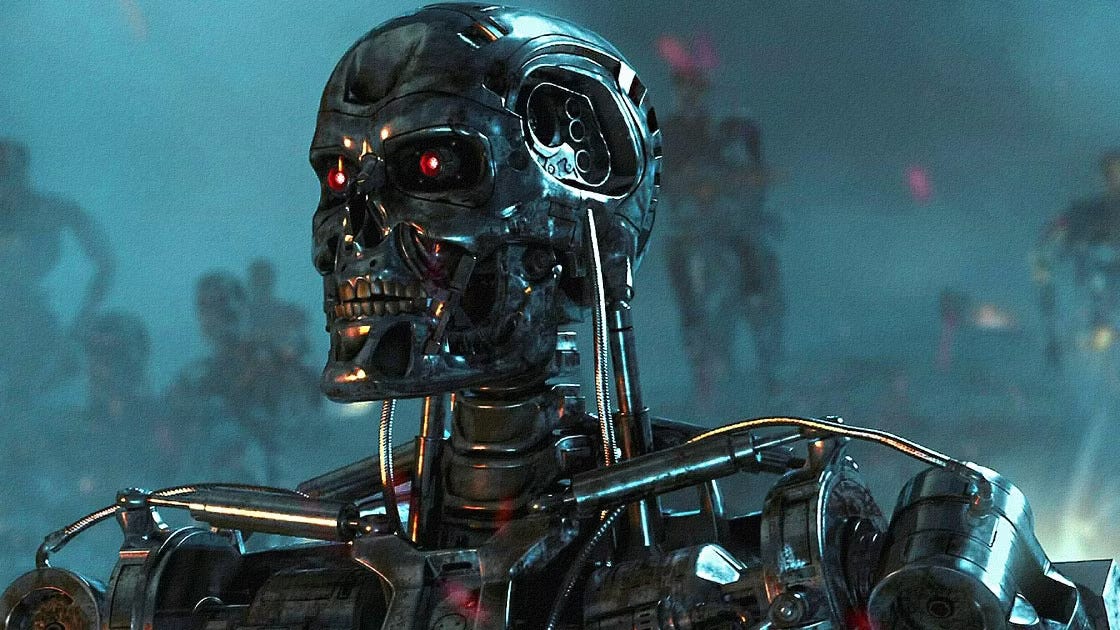
The AI Doomsday scenarios seem like something out of Terminator: out of control super intelligent models maliciously interpreting their prime directives, hacking into weapons systems, creating bioweapons, and unleashing Judgment Day on all of humanity. This similarity is intentional.
The tech industry has always looked to science fiction to inspire innovations, knowing that fictional technologies can serve as both marketing and value proposition for attempted imitations, like when Meta named its failed virtual reality project after Snow Crash’s Metaverse. AI is among the most represented technologies in science fiction: I, Robot, 2001: A Space Odyssey, Bladerunner, Neuromancer, The Terminator. Technology in sci-fi is rarely presented as uncomplicatedly good, one purpose of the genre has traditionally been to explore the existential and moral implications of new technologies. AI, however, stands apart from flying cars, robot butlers, holograms, and teleportation devices as one that is almost always a cautionary tale about what happens when men give their thinking over to machines.
This presents a complicated situation for tech marketers who need to reference sci-fi to link LLMs with the weighty cultural idea of Artificial Intelligence, but to do so is also to link LLMs to the murderous, conscious AI technologies these stories are warning against. In other words, if it doesn’t have the potential to break free, hack the main frame, and risk human annihilation, is it even AI? Is it worth all the investment? So they’ve embraced the Doom.
The severity, scale, and supposed likelihood of these Doomsday scenarios beggars belief: a 10% or higher chance AI will end all life on Earth in just a few years. In the face of the confusing and virtually unheard of situation of capitalists begging to be regulated, it’s worth a pause to ask why? Why would they possibly want this? It stands to reason there is some other purpose beyond pure concern for the human race given these companies have not seemed to slow down the pace of LLM development despite their own rhetoric.
One popular narrative on the left in answer to this question goes something like this: AI companies are dangerously overvalued, they cost galling amounts of money to train, maintain, power, and manage; the data centers alone are a massive investment. However, investment on AI has not yet paid the promised dividends in replacing labor costs en masse or radically improving existing services to entice new business. These improvements will never materialize, because the technology is fundamentally limited (an LLM cannot become a HAL), so the industry is precariously kept afloat by private investment which will eventually dry up, and the bubble will burst. The trick is that, by promising that AI Doomsday, and therefore a sci-fi level AI model, is right around the corner, the investments will keep coming in. What’s more, the AI companies, by demanding these kinds of regulations, are positioning themselves to be the ones that write them, conspicuously leaving out the decidedly uncinematic, more immediate threats to labor, the environment, the minds of children and adults of all ages, that do nothing but limit the profits of these companies. The left should dismiss any talk of existential threat around AI, try to lay out real dangers, and propose regulations that address those dangers.
All in all, I agree with a lot of the broad strokes: I also don’t think it’s possible for an LLM to become sentient, I do think that the AI companies benefit from some of this sci-fi glitz, I agree it is a distraction from those more immediate concerns, and I certainly think they are trying to be the ones to write their own regulations. But this story also glosses over a lot.
The issue is that it’s ineffective rhetoric to say “AI companies are exaggerating the danger, AI does not pose an existential threat…here are the actual issues with AI you should worry about.” Rather than building on and transforming the energy fear provides to a regulatory movement, it grinds momentum to a halt, like stopping an angry mob to make sure everyone is mad about the right things.
This reminds me of a critical mistake made in previous generations of socialists; the idea that before any political action happens, before it’s worth contesting power, the people need to be educated. Even now, I encounter people who claim it was a disqualifying error that Bernie Sanders spoke in terms of a 99% and 1% instead of workers and capitalists. DSA has built a socialist movement because we have never excluded people who wanted to build with us for having the wrong reasoning. In doing so, we’ve also recognized that political education is something that is best built in the practice of organizing; someone can come to an issue with the wrong framing and become aligned from our framing of the solutions. People come to DSA concerned about their cost of living, become exposed to the interconnectedness of all the issues we care about, and become socialists in the process.
There is also an optimism in dismissing fears of AI Doomsday as mere marketing. This optimism is most palpable in the economic bubble piece of this story. For some, the AI bubble bursting functions as a kind of Biblical Flood, promising to wash away all of the issues arising from the AI industry. When it finally happens, we will be free of AI customer service agents, AI psychosis, AI in education, AI taking over our jobs, and so on. Unfortunately, this is generally not how bubbles work. The Dot-com Bubble wiped out many online shopping companies like Pets.com, but Amazon is now one of the most profitable companies in the world.
Even if the bubble pops and AI remains unable to generate enough value to justify continued investment, that still may not be enough. These tools are being used across the federal government already. There is a real possibility that rather than crash the American economy, the government and private investors will keep funding these technologies indefinitely to build AI-powered drones and other instruments of surveillance and violence. We can’t rely on the flood to save us.
Most crucially, the real problem with this narrative is that there are real reasons to be afraid. Not in a “Skynet superintelligent AI turning on humanity in a sci-fi judgment day scenario,” but in the incredibly banal “as soon as the powers that be find AI models sufficiently capable to be put in charge of defense, weapons development and guidance (including bioweapons), and information, they will do it.” Smiling serenely and saying (correctly) AI is not super intelligent or sentient will not stop it from being used as though it is.Therein lies the real existential threat: not Skynet, but Shitty Skynet.
Let’s consider a few AI scenarios that have nothing to do with AI becoming super intelligent or sentient (and may, in fact, be worse if it stays as flawed as it is). None of these are sci-fi doomsday scenarios, but they are catastrophically bad and dystopian:
The Department of Defense integrates AI models into their intelligence apparatus. They are investigating whether Country A poses a threat to the United States. Country A has historically not been a primary target for US intelligence and so there is not a lot of available data on them. Due to various similarities with a previous and well-established threat, Country B, the new information on Country A is close in the data to Country B. The AI model analyzes the limited intelligence collected on Country A and, with multiple queries, eventually pulls in old information about Country B to the report, suggesting Country A poses a threat. The US invades Country A when it poses no such threat. A similar scenario to this almost happened in July, when US forces were about to board a Chinese ship based on a false report from an AI system.
A weapons manufacturer wants to improve real-time targeting using AI so missiles can course correct when a selected target is no longer viable. Consultants calculate an up to 40% reduction of intercepted missiles. Missile programmers train the model on past targets, many past targets have been schools, so naturally these are part of the data. When the US declares war on a country a swarm of missiles is unleashed on a large target. The new real-time guidance model detects anti-missile defenses and defensively selects new targets for the missiles: all nearby schools. The casualties are massive. Again, this scenario is not far from reality. Early in the Iran War, the US bombed a girl’s school in part due to bad intelligence from AI.
Companies all around the country log the keystrokes of employees’ company issued laptops to make sure they aren’t doing anything illegal or against company policy. While in the past this was handled by an individual with some keywords, a new company launches with the promise of detecting inside threats before they happen by analyzing keystrokes for implied meaning, not just keywords. Unionization is one of the threats this software detects, and companies all over the country start using this technology. Thousands of employees complaining about stagnant wages and conditions in private messages sent from their laptops are quietly labelled instigators, and are unceremoniously fired, citing performance issues. None of them ever know why they are fired. In the face of ever higher cost of living and dwindling worker rights, unionizing just became nearly impossible.
ICE has been occupying a city for months and immigrants are disappearing overnight. In response to the crisis, immigrants across the city start following and liking posts from accounts involved in Abolish ICE organizing. Meanwhile, ICE has been using AI and web-crawlers to compile lists of activists, AI is then used to pinpoint other data about them across the internet and run it against DHS’s own database of immigrants. This data is run against local police databases in their collaboration with ICE, any member of the list with outstanding traffic tickets and other minor outstanding charges are deported, citing their “criminal record.”
A criminal organization, using advanced AI models, set out to hack local banks across the country using a recently identified exploit in a commonly used software. While the big national banks will update their software immediately, the hackers correctly expect some smaller banks and credit unions will not have updated to the patched version of the software. The AI model, pulling from public regulatory filings, scrapes IT job postings (which often reveal what software stack a small institution runs), scores each credit union by likely patch status, estimated deposit volume, and how thin their IT security staffing looks. Within hours, the group has a ranked list of institutions, sorted by “highest yield, lowest resistance.” The group instantly coordinates thousands of small, unsuspicious transactions from each bank, adding up to millions of dollars before anything is suspected. This kind of incident becomes routine.
A police officer shoots an unarmed teenager. Outraged, residents of the city where the incident occurred take to the streets in protest. Shortly after, a group becomes rowdy, it’s not really clear who started burning trash cans or breaking windows, and some of the rioters’ shoes look weirdly shiny for a group of protesters. Flock cameras capture the whole scene. A white supremacist hacks the Flock cameras and uses AI image recognition to identify and dox every identified protester. The police later use this information to arrest dozens of protesters.
Many of these scenarios are imminently possible, and require immediate intervention to prevent. Versions of some of them are dangerously close to occurring. Doomsday may be slower and more boring that the AI companies want you to believe, but accelerating already existing crises may well spell our doom. Take all of these scenarios together and you have a world that is profoundly dystopian, not a far cry from some sci-fi dystopias, not Skynet, but Shitty Skynet. Yes, the human race still exists, but do we want to live in this world? Of course not, and we have a duty to stop it from coming into being.
When we make opposing AI Doomsday narratives central to our organizing, there is a real risk of us missing the moment. The idea that if we acknowledge any existential risk we’re handing the AI Companies the ability to write their own legislation just doesn’t follow; they will try to write their own regulations no matter what we do. And according to a recent poll showing a majority of Americans believe there is an existential threat, we’re fighting an uphill battle over the cause for concern, when we should be focused on providing the solutions.
DSA is uniquely positioned to cut through the think-pieces and X dot com arguments and present a unified platform for AI Regulation. When we get the parents who are terrified their child won’t learn to think for herself, the rural woman who is being driven crazy by the sound pollution of data centers, the working class family whose energy bills have skyrocketed, the adult son of a lonely woman who has developed AI psychosis, the old hippie worried about climate impact, and yes, the majority of Americans who are sincerely worried there is a chance it will kill us all, all united on a shared regulatory platform, we have a real shot at forcing the full spectrum of reforms we need to meet this moment.
A platform of regulations, covering the gamut of labor concerns, education, frontier development, environmental concerns, safeguards to detect unhealthy use, age restrictions, data center construction, and the use of AI in policing, the military, and intelligence would provide something for this burgeoning coalition to unite behind.
When AI companies shout down to the workers of the world that they are building a dangerous technology that will wipe out humanity, we should answer back, “you are building a dangerous technology, and here’s what we’re going to do about it.”

Good piece. This is well worth reading as well: https://abiawomosu.substack.com/p/the-machine-alibi-unpacking-the-myth?r=21x2h&utm_medium=ios