

Earlier this week, Jacobin Magazine released a report titled the “Working Class Win-O-Meter: Dialing up to Victory,” which aims to help candidates win over working class voters. While the report uses extensive polling and novel approaches, it provides very little broader strategies for how Democrats can win over the working class. Even worse, it justifies reactionary views on social issues including immigration and trans rights. Win-O-Meter treats politics as though it were a series of dials a candidate can “turn” in order to win an election. This is a naive and incorrect view of politics, one that narrows our horizons and actually prevents us from winning.
In writing the report authors Jarod Abbot and Joan C. Williams created a series of hypothetical candidates with varying backgrounds and positions and then polled “working class” voters (we’ll get to their definition of working class in a minute). Their polling was extensive, surveying over 40,000 people. Win-O-Meter finds that candidates who adopt popular, somewhat moderate economic populist policies and take reactionary views on some social issues, such as policing, abolishing ICE, and trans girls in sports, see a meaningful bump in support from “the working class.”
The report argues that there are six framings a candidate can adopt: “the economic agenda they foreground, the culture and climate policies they adopt, whom they center in their messaging, the values they invoke, the populist tone they strike or not, and their class background.” If a candidate adopts all six framings a candidate can increase their vote share by up to 10.9 points. But there are a myriad of problems with the assumptions Win-O-Meter makes and the conclusions it draws.
To begin with, political polling reports like Win-O-Meter often try to give off an air of neutrality, but there is no way to run a neutral poll, let alone draw conclusions from one. The first sign that this report has its own biases is who it chose to define as working class: low and middle income voters without a college degree. Since there is no universal agreed upon criteria for what makes someone working class, this poll uses voters without a college degree as a proxy. But many would disagree with this criteria. Are nurses, teachers, and social workers not working class? Furthermore there is plenty of data that shows that voters without college degrees vote to the right of their college educated counterparts, meaning this report, by definition, is going to depict a more conservative working class than one that includes college educated voters.
The report also hides their definition of working class voters, not including it in their executive summary. This is a clever bit of sleight of hand that allows them to claim that they have successfully polled the working class, when in reality they have polled non-college educated voters.
There is of course no universal definition of working class. Is the working class anyone who makes under $250,000? Is it anyone who works for a paycheck? Is it anyone who drives a pickup truck? In selecting who is working class and who isn’t, the report biases its results from the very start. Of course, there is no way to not bias a report like this; how you define working class will determine the result.
Had the report argued that politicians can win over non-college educated voters with a mix of moderate economic populism and some reactionary social views, it would have been a lot more honest. It also wouldn’t have been particularly groundbreaking.
But the problems with Win-O-Meter go deeper than how its authors define the term “working class.” The very thesis of the report, that there are “dials” a candidate can turn to win an election, is fundamentally flawed.
This report falls into the trap of popularism, a term coined by pollster David Shor and boosted ad-nausem by Matt Yglesias. Popularism contends that the best way for a candidate to win is to adopt issues that are broadly popular. While this is straightforward enough, in practice it leads to some pretty awful politics. The most unpopular Prime Minister in British History, Keir Starmer, adopted popularism to devastating effect. He took a hardline immigration stance that alienated his supporters and did nothing to boost support for labor amongst right wing voters.
The report has a list of preferred policies that they say poll the highest, that one could say are popular.
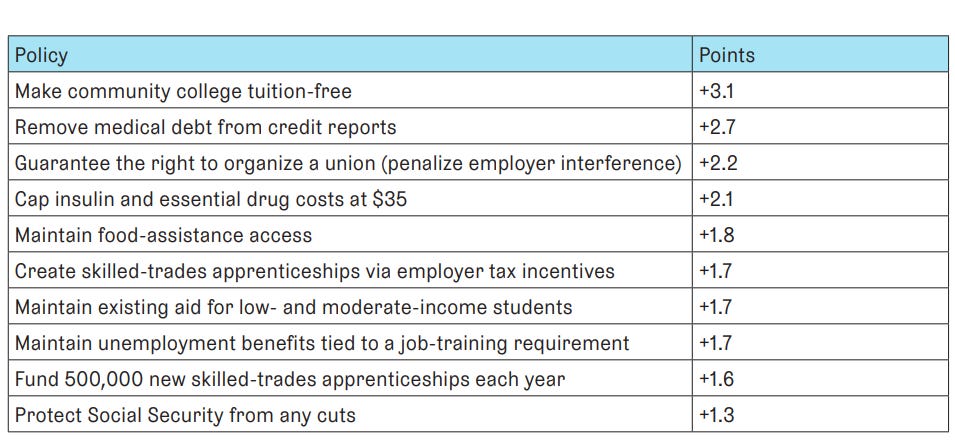
Imagine a campaign where these policies were its centerpieces? This wouldn’t be a socialist campaign. Hell, it wouldn’t even be a progressive campaign. With the exception of guaranteeing the right to organize, moderate Democrats are already running on platforms that look exactly like this! This is the exact same approach that led to Starmerism.
A politician cannot just say the things voters want them to say. Politicians must offer a compelling narrative for why things are the way they are, how they will change them, and why they are the right person for the job. Polling is useful for refining that narrative, but it cannot be used as a compass. Politicians must define themselves on their own terms, not on what polls well.
Politics is a story, played out on a national stage. Trump’s 2024 platform, laid out in Project 2025, was wildly unpopular, but that didn’t matter for his narrative. He was a businessman, who oversaw a historic period of economic growth in his first term and would bring prices down in his second. Trump’s predecessor, Barack Obama, might be the most talented narrative politician of the 21st century. No one remembers the specific policies he ran on in 2008, but they do remember “Hope” and “Change.” Obama’s narrative was simple: “After the disastrous war in Iraq, we need new and better leaders.”
In fairness to the report, the authors do acknowledge the vital role of storytelling in politics, but they fail to understand that in the very act of developing the report, they have already chosen a narrative direction—America is broken because of cosmopolitan and educated elites. They are telling a story about the educated versus the uneducated. The polling helps refine it.
In pursuing their narrative, the authors make their most disturbing conclusions: that candidates should moderate on social issues. Win-O-Meter found that candidates who supported “letting trans girls play in women’s sports” will suffer a measurable drop in support. They encourage candidates to find policies that “resonate” with the working class. But using polling to determine human rights policies is an inherently dangerous game. Majorities of Americans oppose minors receiving puberty blockers, but puberty blockers are absolutely crucial healthcare for trans kids. Even the example of sports is one where tremendous harm can be done to trans kids. Plenty of trans girls find love and community in their sports teams. Trans girls shouldn’t have their rights taken away because they don’t poll well.
Win-O-Meter does acknowledge that if a candidate is going to take an unpopular position, they should not center it in their campaign. They call this the “Mamdani Effect,” after Zohran Mamdani, who was quite adept at reframing questions to focus on cost of living concerns. They malign “Kamala Harris Style” candidates who make social issues the center of their campaigns, but when it comes to trans rights, no major candidates are making them the center of their campaigns. In fact it was Trump who made trans issues the center of the 2024 campaign, not Harris.
Win-O-Meter’s argument is clear: “Taking resonant rather than nonresonant positions on cultural issues could be a key ingredient in Democrats’ formula for winning back many of the Trump-curious voters who went Republican in 2024, at no cost — and often at a modest advantage — for the existing base’s support.”
Michigan Senate Nominee Abdul El-Sayed offers an alternative. When asked by professional ghoul, Jesse Waters, about his position on trans girls in sports, El-Sayed replied that this is a silly issue (it is) and that existing sports governing bodies can handle it (something they’ve been doing for decades). When asked about gender affirming surgeries for minors, El Sayed said that was between children, their parents, and their doctors, then started asking Waters if he was circumcised, showing just how weird and silly this whole thing is. He didn’t say that trans girls don’t belong in sports like his Texas counterpart James Talarico. He didn’t say that minors shouldn’t receive gender affirming surgery. He stood his ground and reframed the question.
In the same section on social issues, Win-O-Meter points out that abolishing ICE does not poll well among its non college educated respondents, but offering a path to citizenship does. The problem here is that ICE is a fascist paramilitary organization currently recruiting the most zealous Trump supporters into its ranks. Democrats must abolish ICE or risk having American Stormtroopers undermine Democracy. There’s no middle ground here. Candidates must use their platforms to communicate the ongoing dangers of ICE and why it must be abolished.
What might best show the limits of this report is the fact that the authors group the climate crisis with cultural issues. The climate crisis has the potential to wipe out much of the material basis for human civilization; that it has been treated as a cultural issue is a grotesque failure of our politics. Instead of imagining how climate can break out from being a cultural issue and take its rightful place as an economic one, the authors accept the idea that it is a cultural issue and move on.
Ultimately Win-O-Meter suffers from a lack of imagination. Most of the messages and policies it polls are generic ones that voters have heard a million times. Its authors do not push the envelope. They do not imagine a different kind of politics.
Socialists cannot win over the working class by turning various hypothetical dials. They can only win over the working class with a mass movement that redefines the cultural and political ground that we all stand on. It is only through winning hegemony that socialists can remake our economic system. Polls can help us get there, but we shouldn’t let them dictate our strategy. Keir Starmer learned that the hard way.
Left candidates are winning across the country, opening up a new frontier for socialist politics. But our policies and vision feel stuck, as though we’re fighting an endless 2024 presidential campaign. As socialists step onto the national and global stage, we need policies that match the ambitions of our political goals. Win-O-Meter does not stake out anything new and instead holds us in the past. It’s time to move forward.
Great piece. I don't know if you noticed, but if you look at the online appendix you'll see that there definition of working class also includes an income floor of $30,000. So someone working full time at the minimum wage doesn't qualify as working class, by their definition.